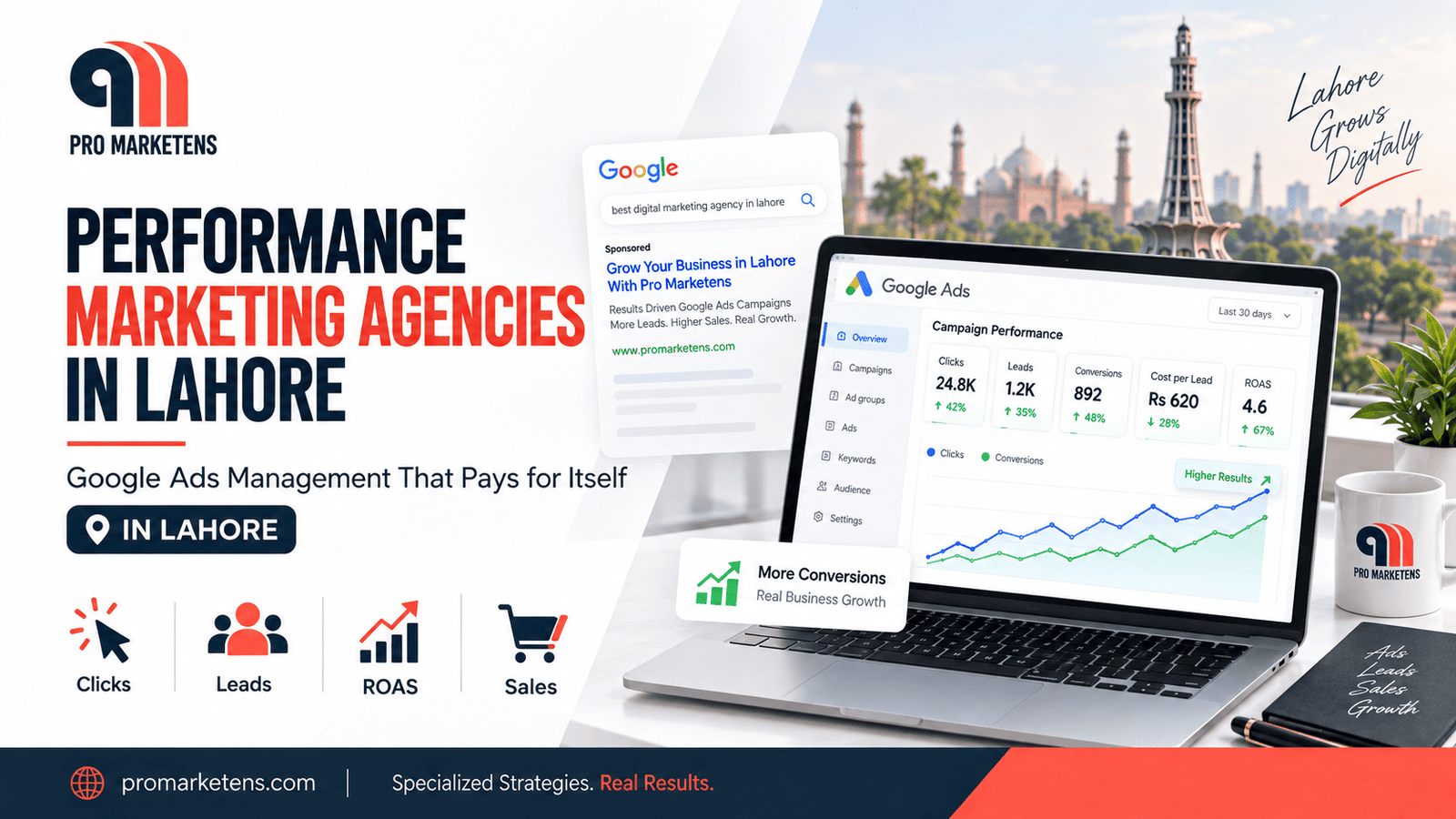
Performance marketing is broader than PPC. It covers every paid channel — Google, Meta, TikTok and more — judged on measurable revenue rather than clicks, with conversion rate optimisation and tracking built in. This guide explains how performance marketing works for Lahore businesses, and how it differs from hiring a PPC-only agency.
This article breaks down what separates real performance marketing from ad spend dressed up in a trendier name, and what proper Google Ads management services Lahore businesses should expect actually looks like when it is built around numbers rather than promises.
Performance Marketing vs PPC: How They Differ
PPC is one channel. Performance marketing is a model for running paid media. That distinction matters, because a business can buy clicks very efficiently and still not improve its revenue, if the clicks go to the wrong audience, the wrong offer, or a page that does not convert.
Under a PPC-only view, success is often judged by traffic: impressions, clicks and a low cost per click. Under a performance marketing view, the question is broader and more demanding: which spend produced enquiries, sales or other measurable returns, and at what cost? Budget follows that answer across channels, rather than staying loyal to a single channel out of habit. PPC may still be the strongest channel for a business, but in a performance model it has to earn its budget alongside paid social, video and remarketing, on the same evidence.
This also changes who is accountable for what. A PPC-only brief can end at the click. A performance brief continues past it, into the landing page, the offer, the follow-up, and the way results are measured. If a campaign brings traffic but no customers, that is not treated as a traffic problem alone; it is treated as a whole-journey problem, and the fix may sit in the creative, the page, the targeting or the budget allocation, not only in the ad platform.
The Channels in a Performance Mix
A performance mix is chosen per audience and per funnel stage, not by habit. Each channel reaches people in a different state of mind, so each needs a different job and a different measure of success.
Paid search, paid social, remarketing and video
Paid search reaches people who are actively looking, so it is often the strongest channel for capturing existing demand and enquiries. Paid social, including Meta, reaches people based on interests, behaviour and demographics, so it is better suited to creating demand, introducing a service, and reaching audiences who are not yet searching. Remarketing and display keep a business visible to people who have already shown interest, encouraging them to return when they are ready. Video can explain, demonstrate and build trust before a person is ready to enquire, especially for services that need explanation or reassurance.
The mix should follow the funnel. Early-stage work may need broader reach and clear education. Mid-stage work needs comparison, proof and a reason to choose one provider over another. Late-stage work needs a direct path to enquiry or purchase, with no unnecessary friction. A channel is not good or bad in itself; it is well or poorly matched to the stage it is asked to serve.
Tracking First: The Measurement Layer
Performance marketing cannot work on guesswork. Before budgets move, the measurement layer has to record what happens after the click, in a way that can be compared across channels.
Conversion events, pixels, tags and reporting
Conversion events are the defined actions that count as results: a form submission, a phone call, a booking, a purchase, or another action the business genuinely values. Pixels and tags are the tools that record those actions on the website and send them back to the advertising platforms and to reporting tools. When they are set up consistently, a business can see which channels and campaigns contributed to enquiries, rather than only which ones produced clicks.
Reporting in the style of GA4, with events and user journeys rather than only page views, supports that comparison, because it shows what visitors did, not only where they landed. Clean data matters more than a large dashboard. If events are double-counted, misnamed or missing, every later decision, including budget shifts and creative changes, rests on a distorted picture. That is why decisions need clean data before budgets move: moving money on faulty measurement can scale the wrong channel with great confidence.
CRO: Turning Clicks Into Customers
Conversion rate optimisation, or CRO, is the work of improving what happens after the click. It is often the cheapest way to improve performance, because it increases the value of traffic that is already being paid for, rather than requiring more traffic at the same conversion rate.
Landing page testing, offer clarity and form friction
Landing page testing compares versions of a page to see which one produces more enquiries or sales. The changes tested are often practical rather than dramatic: a clearer headline, a simpler explanation of the offer, a more visible next step, or a shorter form. Offer clarity matters because visitors decide quickly whether a page matches what they wanted; if the offer is vague, or if the page tries to sell everything at once, many visitors leave without acting.
Form friction is another common barrier. Every extra field, confusing question or slow step gives a motivated visitor a reason to stop. A form should ask for what is genuinely needed to start the conversation, and nothing more at that stage. A/B testing discipline means testing one meaningful change at a time where possible, running the test long enough to learn from it, and keeping the winning version only when the evidence supports it, rather than changing pages on a hunch and losing the lesson.
Attribution: Reading Revenue Without Fooling Yourself
Attribution is how credit for a sale or enquiry is assigned to the channels and campaigns that touched the customer along the way. Done carelessly, it can make any channel look like the hero, or make a valuable channel look worthless. Done thoughtfully, it gives a fairer, if still imperfect, picture.
Last-click limits, blended views and incrementality
Last-click attribution gives all the credit to the final click before conversion. That is simple, but it ignores earlier work: the social ad that introduced the business, the video that explained the service, or the search that first put the business on the shortlist. Judging only by last click can therefore starve the channels that create demand, while rewarding only the channel that closes it.
A blended view looks at cost per acquisition and return on ad spend across the whole mix, alongside channel-level results, rather than treating one number as the whole truth. Incrementality thinking asks a harder question: would this sale or enquiry have happened anyway, without this spend? Not every question can be answered precisely, and no attribution model should be presented as exact. The goal is to avoid being fooled by a single, flattering number, and to make budget decisions that hold up when several views are compared.
How Budgets Get Allocated
Budget allocation in performance marketing is an active decision, not a fixed split. It starts with a test budget: a deliberate, limited amount set aside to learn whether a channel, audience or creative approach produces measurable results, before it is given a larger share of spend.
Test budgets, kill and scale rules
Kill and scale rules make those decisions less emotional. A campaign, audience or creative that spends its test budget without producing the results it was set up to deliver should be paused or changed, not kept running because it was expensive to build or because it produces clicks. A campaign that consistently produces enquiries or sales at an acceptable cost per result can be scaled, gradually, while watching whether the extra spend keeps producing results at a similar cost. Scaling too fast can exhaust the best audience or push spend into weaker placements, so growth should be earned in steps, with the same evidence checked at each step.
Over time, this moves spend toward the channel and creative that returns, and away from work that only looks busy. The point is not to punish a channel for a slow start, but to give every part of the mix a fair test, a clear goal, and a decision based on results rather than on preference or precedent.
Creative Is a Performance Lever
Creative is often treated as decoration, but in paid social and video it is a performance lever in its own right. The same audience and budget can produce very different results depending on the message, the opening, and the offer presented to them.
Testing cycles, hooks and iteration
Creative testing works in cycles. A hook is the opening idea that earns attention in the first moments, whether it is a clear problem, a surprising statement, a question the audience recognises, or a direct benefit. Different hooks should be tested against the same audience and offer, so the learning is about the message rather than about a change in targeting at the same time. Winning hooks are then iterated: the same idea is refined, given a new visual, a clearer call to action, or a different proof point, while losing ideas are retired.
This cycle matters because audiences tire of the same ad. Even a strong creative loses impact over time as the same people see it repeatedly. A regular supply of new variations, tested against what has already worked, keeps the account learning and prevents performance from fading simply because the creative has grown stale.
The Monthly Optimisation Loop
Performance marketing is a loop, not a launch. Each month should follow the same discipline: measure what happened, learn from it, reallocate budget and effort toward what worked, and test something new based on that learning.
What a performance report should show
A performance report should show spend by channel, enquiries or sales by channel, cost per result, and how those figures changed compared with the previous period. It should also show what was tested, what was learned, which campaigns were paused or scaled, and what will be tested next. It should be honest about weak results as well as strong ones, because a report that only celebrates makes the next month harder to improve.
When that loop runs consistently, performance marketing stops being a set of separate campaigns and becomes a system: tracking tells the truth, creative and landing pages are improved on evidence, budgets follow results, and each month starts from a clearer picture than the last. That system, rather than any single channel, is what separates performance marketing from simply buying ads.
Our paid search marketing team manages Google Ads campaigns for Lahore businesses that need measurable returns.