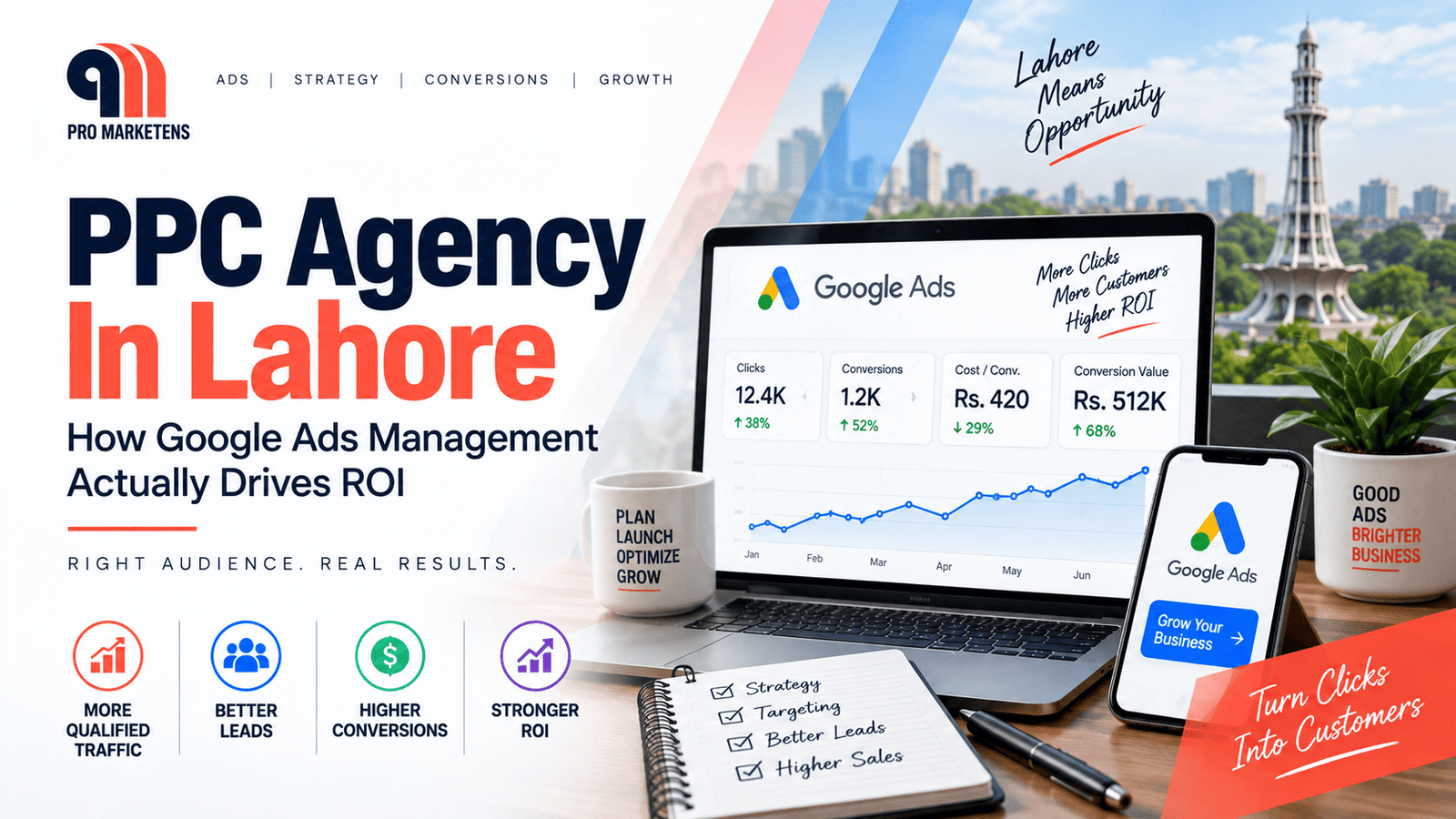
A business owner in Lahore once spent three months running Google Ads on his own before calling an agency, not because the ads were not getting clicks, but because the clicks were not turning into customers and he had no idea why. This is the most common story behind searches like PPC agency in Lahore and Google Ads agency Lahore. The problem is rarely a lack of traffic. It is traffic that costs money and converts into nothing.
This article walks through where PPC budgets actually go wrong, what proper pay per click management Pakistan businesses should expect looks like, and how a Google Ads account gets built to actually return money rather than just spend it.
What a PPC Agency Actually Does
Pay-per-click management is not a single task. It is a set of recurring jobs that keep an account honest, focused and responsive to what searchers actually do. A PPC agency plans the account, builds it, watches it every week, and changes it when the evidence says a change is needed. Without that routine, even a well-built account drifts: search behaviour changes, competitors enter the auction, and ads that once worked stop matching what people want.
Research before any spend
Good management starts before an ad is written. The agency studies what people search for, how they phrase their needs, which searches suggest a real intention to enquire or buy, and which ones are only research. It also looks at the business itself: what it sells, who it serves, where it can deliver, and what a worthwhile enquiry or sale looks like. That research shapes keywords, ad groups, landing pages and budgets, so spend follows intent rather than volume alone.
Builds, bids, testing and reporting
Building means setting up campaigns, ad groups, ads and tracking in a structure that can be read and managed, not a tangle that hides waste. Bid management means adjusting bids and budgets as performance data accumulates, rather than leaving them fixed. Testing means comparing ad variations and landing page approaches in a disciplined way, so improvements are based on results rather than opinion. Reporting means explaining, in plain terms, what was spent, what it produced, and what will change next. Day to day, that cycle is the job.
Google Ads Campaign Types
Google Ads is not one kind of campaign. Different campaign types serve different moments in a buying journey, and choosing the wrong type for the goal is a common source of waste. A sensible account usually uses more than one type, but each one needs a clear job.
Search campaigns
Search campaigns show text ads when someone types a query into Google. They are the closest match to active demand: the person is already looking. Use Search when you want to capture enquiries from people who know what they need, such as a service, a product category, or a local provider in Lahore.
Performance Max campaigns
Performance Max campaigns can show ads across Search, Display, YouTube, Gmail and other Google inventory from a single campaign, using supplied headlines, images, videos and audience signals. Use them when you have clear conversion goals, good creative assets and enough conversion data for the system to learn from. They are not a substitute for a well-structured Search account, and they need careful asset and audience-signal input rather than being left entirely to automation.
Display, YouTube and remarketing
Display campaigns place image and banner ads on websites in the Google Display Network. They are useful for visibility and for reaching people earlier in their research, rather than for capturing immediate enquiries. YouTube and video campaigns do similar work in a more visual form: explaining a service, showing a product, or building familiarity before someone searches. Remarketing shows ads to people who have already visited your website or interacted with your business, reminding them to return and complete an enquiry. Remarketing works best when the audience is defined by a meaningful action, such as visiting a service page, rather than by every visitor.
How a Google Ads Account Should Be Structured
Structure is what makes an account manageable. When campaigns and ad groups are organised by intent and theme, you can see which searches, ads and pages are working, pause what is not, and move budget with confidence. When everything is lumped together, good and bad performance hide inside the same averages.
Campaigns and ad groups by intent and theme
A campaign usually groups work by a shared goal, budget or location. Inside it, ad groups should each cover one tight theme, so the ads and the landing page can speak directly to that theme. For example, separate ad groups for different services, product types or customer needs keep ad copy relevant and make search-term review far easier. Broad, mixed ad groups force generic ads that match nothing well.
Naming and geo targeting for Lahore and Pakistan businesses
Clear naming matters more than it sounds. A consistent pattern that names the campaign type, service and location lets anyone read the account quickly and spot errors. Geo targeting should match where the business can actually serve customers. A Lahore business that serves only the city should not pay for clicks from areas it cannot serve, while a business that ships or serves clients across Pakistan needs a wider, deliberate setting, with location options checked so ads reach people in the target area rather than merely people interested in it.
Keyword and Match-Type Strategy
Keywords decide which searches can trigger your ads, but match types decide how closely a search must relate to a keyword before the ad shows. Getting this balance right is the difference between reaching buyers and paying for curiosity.
Intent tiers
It helps to think in tiers. High-intent searches name a service or product and suggest the searcher is ready to act, such as hiring an agency or buying a service in Lahore. Mid-intent searches compare options or ask how something works. Low-intent searches are broad, informational or job-seeking. High-intent terms usually deserve the most direct ads, the most specific landing pages and the closest attention, while lower-intent terms need a clear reason to be included at all.
Exact, phrase and broad match, with negatives
Exact match gives the most control, showing ads for searches with the same meaning as the keyword. Phrase match allows extra words before or after, as long as the meaning stays intact. Broad match gives Google the most freedom to match related searches, which can uncover useful terms but can also pull in irrelevant ones. Broad match without negative keywords is one of the fastest ways to waste budget. Negative keywords block searches that should never trigger an ad, such as free, jobs, or unrelated services, and they should be added from the start and updated as new search terms appear.
Search-term reviews
Search-term reviews are the regular habit of looking at the actual queries that triggered ads, not just the keywords you entered. This review finds irrelevant terms to exclude, useful new terms to add as keywords, and ad groups where a query belongs somewhere else. Done weekly in an active account, it keeps targeting honest and stops small leaks from becoming a large share of spend.
Ad Copy That Earns the Click
An ad earns a click when it matches the search, sets an accurate expectation, and makes the next step obvious. Clever wording that attracts the wrong visitors is not a success, because the click is paid for whether or not the visitor becomes a customer.
Responsive search ads
Responsive search ads let you supply multiple headlines and descriptions, and Google combines them into ads for each search. The strength of this format is variety, but variety needs guidance. Supply headlines that cover the service, the location, the benefit and the call to action, and write descriptions that support them without repeating the same line. Weak or near-duplicate headlines waste the format.
Pinning, and assets that support the ad
Pinning a headline or description to a fixed position can protect a message that must always appear, such as a brand name or a key service line, but over-pinning reduces the combinations Google can test, so it should be used sparingly and for a reason. Assets, formerly called extensions, add useful detail around the ad. Sitelinks point to specific pages, such as services or contact information. Callouts add short selling points, such as a service feature or a way of working. Call assets make it easy for a searcher to phone the business directly. Together, these assets make the ad larger, more informative and more likely to match what the searcher wants next.
Landing Pages and Conversion Tracking
A click is only the first half of the journey. The landing page decides whether that click has a chance to become an enquiry, and conversion tracking decides whether anyone can tell.
Message match and one goal per page
Message match means the landing page continues the promise of the ad: same service, same offer, same language, without forcing the visitor to hunt for it. A page built for one goal, such as a form submission, a phone call or a purchase, is easier to act on than a page that offers many competing options. The headline should confirm the visitor is in the right place, the key information should be visible without scrolling through unrelated content, and the next step should be clear and repeated where a longer page needs it.
Why tracking must come before scaling spend
Conversion tracking records the actions that matter, such as form submissions, calls or purchases, and connects them back to campaigns, ad groups and keywords. Without it, an account can only be judged on clicks and impressions, which say nothing about whether the business gained customers. Increasing spend before tracking is in place simply scales an unmeasured result. With tracking in place, the agency can see which searches produce enquiries, which produce nothing, and where additional budget is justified.
Bidding, Budgets and the Optimisation Rhythm
Bidding and budgeting are not set-and-forget decisions. They should follow the stage of the account and the quality of its data, and they should be revisited on a rhythm, not only when something goes wrong.
Bid strategies by stage
Early in an account, when conversion data is thin, manual or more controlled bidding can help gather clean information about which keywords and ads deserve attention. As reliable conversion data builds up, automated strategies that optimise for conversions or for a target cost per conversion can take more of the routine work, provided the conversion actions are defined correctly. The right strategy depends on the goal, the volume of conversions and how stable the account is, not on a preference for automation alone.
Weekly and monthly optimisation tasks
Weekly work typically includes search-term review, adding negatives, checking budgets, reviewing ads that need new variations, and pausing keywords or ads that spend without producing results. Monthly work steps back further: reviewing campaign structure, landing page performance, geo and audience settings, and whether budget is still allocated to the campaigns that earn enquiries. Pausing losers is not failure; it is how budget is freed to scale winners. Scaling a winner should be gradual, with attention to whether extra spend still brings enquiries at an acceptable cost, rather than simply raising a budget and hoping.
Common Google Ads Mistakes
Most wasted Google Ads spend comes from a small set of avoidable mistakes. The first is broad keywords with no negatives, which invites searches far outside the business and pays for them anyway. The second is sending all traffic to the homepage, where visitors must work out for themselves where to go next, instead of landing on a page built for the ad they clicked. The third is running without conversion tracking, which leaves the account judged on clicks while nobody knows which clicks became customers. The fourth is the set-and-forget account: campaigns launched, then left untouched while search behaviour, competition and ad relevance move on. Each of these is fixable, but only if someone is looking at the account regularly enough to notice.
Reporting: What You Should See Every Month
A useful monthly report answers a simple question: what did the spend produce, and what changes next? It should show spend and clicks, but those figures only make sense beside conversions and cost per conversion, so you can see whether enquiries are becoming cheaper or more expensive over time. It should also show the search terms that triggered ads, including any irrelevant terms that were excluded, and the campaigns and ad groups that produced results compared with those that did not.
Just as important as the figures are the next actions: which keywords will be paused or added, which ads will be tested, which landing pages need attention, and where budget will move. A report with no next actions is a summary, not management. A report that explains changes in plain language, and ties them to enquiries rather than to clicks alone, is what a business owner should expect every month.
Want this handled for you? See our paid search marketing services for Google Ads management built around return on ad spend.